Two hotels — one city property and one resort — sold rooms months in advance and then watched a large share of bookings disappear before arrival. Empty rooms on the night were lost revenue; accepting too few bookings to protect against that risk produced the same result. Overbooking was handled by habit and season, not by a view of which bookings were likely to cancel.
The revenue decision
For each arrival date and room type, the revenue team had to decide how many rooms to sell beyond physical capacity, which rates and deposit conditions to attach, and when to stop selling. The useful question was not "will this booking cancel?" on its own. It was "what does this booking contribute if it stays, what does it cost if we walk a guest, and what overbooking level maximises expected net revenue?"
What we worked with
- Bookings: 119,390 records across a city hotel (about 79,000) and a resort hotel (about 40,000), covering arrivals from 2015 to 2017.
- Booking attributes: 32 fields including lead time, market segment and distribution channel, deposit type, previous cancellations, special requests, room type, meal plan, average daily rate and country.
- Outcome: whether the booking was cancelled before arrival — roughly 37% overall, with the resort materially lower than the city property.
- Cost context: room revenue, commission and discount treatment, walk compensation and the operational cost of a relocation.
One property's pattern did not transfer directly to the other. Seasonality, channel mix and guest composition were different enough that a single policy across both hotels would have averaged away the decision that mattered.
The traps we designed around
- Leakage from status fields. Reservation status and assignment are recorded at or after arrival. A model that uses them predicts the past; only fields known at booking or at a defined review point were allowed in.
- Cancellations are not random. Lead time, channel, deposit type, group bookings and previous cancellations all predict cancellation. A model that ignores them will systematically overbook the wrong dates.
- Occupancy is not revenue. A filled room at a discounted rate can be worth less than an empty room held for a higher-paying late booking. Policies were judged on expected net revenue, not occupancy percentage.
- The cost of a walk is asymmetric. An empty room costs one night's revenue; walking a guest costs compensation, transport, goodwill and future bookings. The overbooking level must reflect that asymmetry, not a simple average.
- Policy changes behaviour. Adding a deposit can reduce cancellations and also reduce direct bookings. The effect of the policy is not the same as the effect of the segment that chose it.
- Groups and duplicates. Group blocks and multiple reservations attached to one stay distort both the cancellation rate and the overbooking calculation unless they are reconciled first.
How the policy view was built
- Define the decision point. Cancellation probability was estimated at booking time and again at a fixed review window before arrival, with different features available at each point.
- Reconcile the booking base. Group blocks, duplicates and zero-value reservations were identified, and city and resort hotels were modelled separately.
- Build a time-aware validation. Bookings were split by arrival date rather than at random, so the model was tested on future business conditions rather than on a shuffled version of the same period.
- Model cancellation and value together. A calibrated cancellation model was combined with expected room revenue, channel cost and stay length. Calibration mattered because the output feeds a capacity calculation, not a ranking alone.
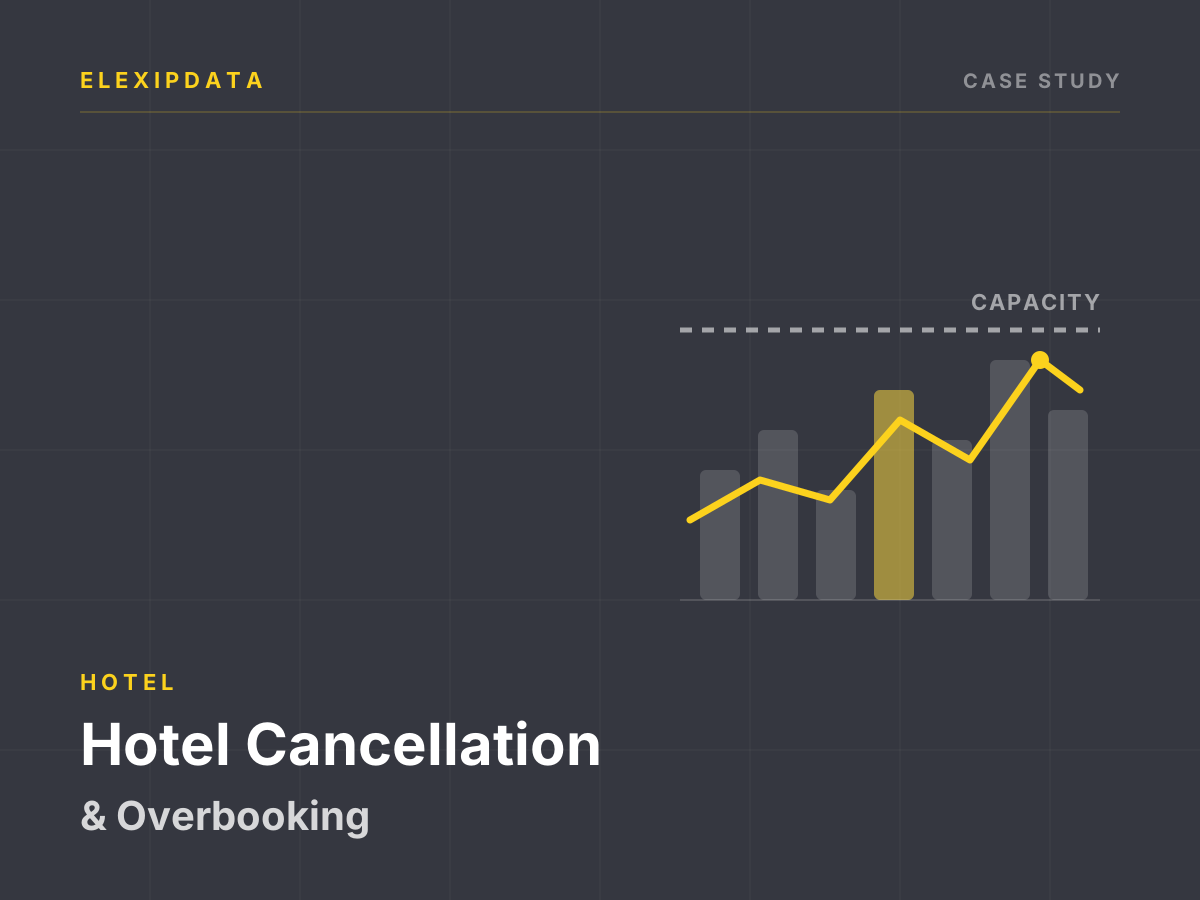
- Simulate overbooking levels. For each date and room type, we simulated net revenue across candidate overbooking limits, using the cancellation distribution and the cost of walking a guest. The result is a curve with a defensible operating point, not a single guessed number.
- Translate into policy rules. Deposit and refund conditions were evaluated by segment, with attention to selection effects and to regulations that limit what can be differentiated.
- Monitor the outcomes that matter. Cancellation rates, walk events, net revenue per available room, channel mix and calibration were reviewed weekly during the first months.
What this changes
- Overbooking becomes a calculated risk. Limits respond to the cancellation profile of each date and room type instead of a seasonal rule of thumb.
- Revenue replaces occupancy as the target. The team can see when holding a room is worth more than filling it.
- Policy is tested, not assumed. Deposit conditions are evaluated for their effect on both cancellations and booking volume.
- Walk risk is visible. The expected cost of relocating guests is part of the decision, not a surprise at the front desk.
What we delivered
- Calibrated cancellation models for each property, with separate booking-time and pre-arrival views.
- Expected net revenue calculations combining room value, channel cost and stay length.
- Overbooking curves by arrival date and room type, with walk cost made explicit.
- A policy matrix for deposits and refundability by segment, with legal and selection-effect caveats.
- A monitoring dashboard for cancellation drift, walk rate, channel mix and net revenue.
Where this applies
This fits hotels, resorts, airlines, car rental and any business that sells a fixed capacity in advance and faces no-shows. The minimum inputs are booking-level history with a clear cancellation or no-show outcome, revenue and cost data, and a defined review point before arrival. The first deliverable is usually the booking-base reconciliation and the walk-cost assumption — because an overbooking model built on duplicated group blocks or an understated relocation cost will confidently produce the wrong answer.
This is an illustrative case study built on an anonymized dataset; it does not report results from a specific client engagement. Cancellation policy also has legal, fairness and customer-relationship dimensions that must be reviewed with the business before any rule is applied.