
A structural shift in the Canadian telecom market
The Canadian telecom market has entered a more mature and efficiency-driven phase.
Recent disclosures from BCE, TELUS, and Rogers Communications point to a consistent pattern in 2025:
- Subscriber growth has slowed materially
- Pricing pressure remains elevated
- ARPU has stabilized in a narrow range (approximately C$55–$57)
- Churn continues to be tightly managed (~1.0%–1.2%)
For example, TELUS reported mobile phone churn of 1.17% alongside an ARPU of C$57.01, with ARPU declining by approximately 2.8% year-over-year. Rogers reported churn of approximately 0.99% and blended ARPU of C$56.70, while BCE experienced a decline of over 30% in mobile subscriber activations despite improving churn to around 1.22%.
Taken together, these indicators suggest that the industry is no longer operating in a demand-driven growth environment.
Growth is increasingly constrained by market saturation and pricing competition, shifting the focus toward efficiency, customer quality, and execution discipline.
Why traditional campaign approaches are losing effectiveness
In a high-growth environment, broad acquisition strategies can remain effective because underlying demand absorbs inefficiencies.
However, as growth slows, those inefficiencies become immediately visible.
Three structural issues tend to emerge:
- Rising acquisition cost
Broad targeting increases spend on low-probability customers, reducing overall efficiency. - Declining conversion quality
Campaigns optimized for volume may attract lower-value customers, putting pressure on ARPU. - Limited performance visibility
Many organizations continue to evaluate campaigns using top-line metrics (e.g., total conversions), without understanding where value is created or lost within the funnel.
This tension is reflected in public disclosures: operators are simultaneously managing declining net additions, stable or declining ARPU, and ongoing promotional pressure.
From campaign execution to system design
In this context, campaign performance can no longer be treated as a series of isolated marketing activities.
Instead, it must be understood as a system-level problem.
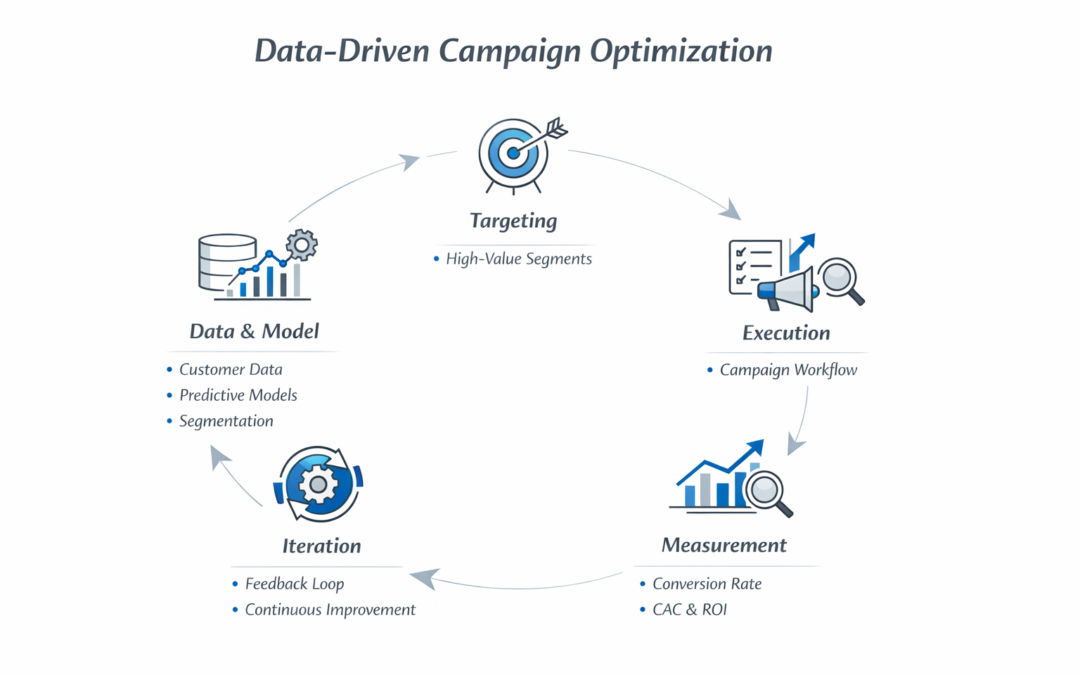
At a high level, effective campaign performance depends on the alignment of five elements:
Targeting → Decision → Execution → Measurement → Optimization
Breakdowns at any stage reduce overall efficiency.
In practice, three structural gaps are most common.
1. Targeting is not aligned with probability or value
Many telecom campaigns still rely on broad segmentation or rule-based targeting.
However, in a constrained market, this approach leads to over-exposure of low-propensity customers.
A more effective approach is to incorporate predictive modeling to estimate:
- Probability of conversion
- Expected customer value (e.g., ARPU potential, retention likelihood)
This enables prioritization of high-value segments and more efficient budget allocation.
The objective shifts from reaching more customers to reaching the right customers.
2. Execution lacks consistency and control
Even when targeting is well designed, execution often introduces variability.
Typical issues include:
- Inconsistent follow-up timing
- Lack of ownership across leads
- Variation in channel usage and sequencing
This creates performance variance that cannot be explained by data alone.
From an operational perspective, campaign execution should be structured as a defined workflow:
Scored → Targeted → Contacted → Engaged → Converted
With clearly defined rules governing:
- Timing of actions
- Number of contact attempts
- Channel allocation
Consistency in execution is a prerequisite for reliable performance.
3. Measurement focuses on outcomes, not drivers
Campaign performance is often evaluated using aggregate metrics such as:
- Total conversions
- Overall response rates
However, these metrics do not explain why performance changes.
A more effective approach is to analyze performance at the funnel and segment level, including:
- Conversion rates by probability segment
- Drop-off points between stages
- Channel-level performance variability
For example, in many telecom campaigns, a significant drop-off occurs immediately after the first contact—indicating that initial engagement, rather than targeting volume, is the primary constraint.
4. Optimization is not embedded into the system
Many organizations treat campaign analysis as a post-hoc reporting exercise.
However, in a slower-growth environment, performance improvement depends on the ability to continuously learn and adapt.
This requires a structured feedback loop:
Campaign Results → Model Update → Strategy Adjustment → Next Campaign
Key elements include:
- Recalibration of predictive models using new data
- Adjustment of targeting thresholds based on observed performance
- Reallocation of budget across channels and segments
Sustainable improvement is achieved not through isolated changes, but through iterative system refinement.
Implications for telecom operators
The implications of these structural shifts are clear.
In an environment characterized by:
- Slower subscriber growth
- Stable or declining ARPU
- Persistent pricing pressure
campaign performance becomes a function of precision, not scale.
Organizations that continue to rely on volume-driven strategies are likely to face:
- Increasing acquisition costs
- Lower-quality customer acquisition
- Reduced return on marketing investment
By contrast, those that adopt a system-based approach—integrating data, modeling, workflow design, and continuous optimization—are better positioned to:
- Improve conversion efficiency
- Maintain customer quality
- Enhance overall campaign ROI
Conclusion: Campaign performance is a system capability
The telecom market no longer rewards scale alone.
It rewards the ability to:
- Identify high-value customers
- Execute consistently across channels
- Learn and adapt from data
Campaign performance is no longer a marketing output.
It is a system capability.